

Contributors
Filter contributors by:
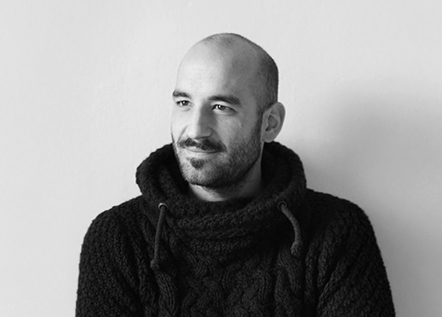
Luca Astorri
Founder of AOUMM and lecturer
An architect who graduated from the Politecnico di Milano, with further studies in Portugal, Luca Astorri began his professional career working with OMA – Office for Metropolitan Architecture, the practice founded by Rem Koolhaas, in Rotterdam. He developed an early interest in international cooperation, working with NGOs such as Liveinslums on architectural projects and research into informal settlements in Cairo and Nairobi. In 2012, together with Riccardo Balzarotti, Rossella Locatelli and Matteo Poli, he founded AOUMM, an architecture and landscape design practice based in Milan, active both nationally and internationally on architecture, landscape and urban planning projects in which diverse disciplinary expertise generates synergies and innovative approaches. Notable AOUMM projects include third prize in the international competition for the new Vigorelli Velodrome in Milan (2012), the Save the Children pavilion at Expo Milano (2015), the first permaculture farm in Azerbaijan (2014), and various exhibition installations at the Galleria d’Arte Moderna in Milan and the Guggenheim Museum in New York. In 2026, the “Punto Luce” facility built in Milan for Save the Children received the Urbanfile Architecture and Urban Planning Prize, an award dedicated to projects that best represent the social value of architecture and urban regeneration, as well as a PEFC mention at the Wood Architecture Prize by Klimahouse. Since 2017, Luca Astorri has also been co-director of Rise International, an NGO based in Lesotho, for which he devised and directs the In-loco programme, a training pathway based on practical learning dedicated to projects addressing social needs, growth, education, architecture and landscape, and promoting youth entrepreneurship in the construction sector.
He teaches the course “Design for Development: Architecture, Urban Planning and Heritage in the Global South” at the Politecnico di Milano, and has taught, lectured and led design workshops at leading academic institutions across Europe, Asia and South America. In 2017, together with the CatalyticAction team, he received the Bronze Award at the LafargeHolcim Awards for the Pavilion Re-claimed project, a redevelopment of a pavilion from Expo Milano 2015 converted into a school for Syrian refugees in Lebanon.
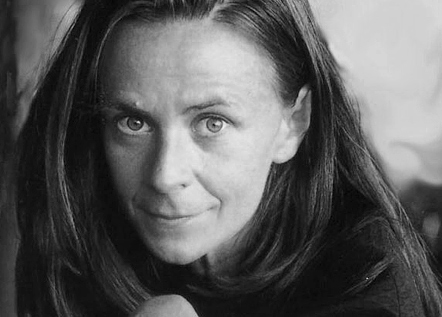
Alessandra Battisti
Architect, PhD, Lecturer
Full Professor of Environmental Technological Design at the Department of Planning, Design and Technology of Architecture (PDTA) of the Faculty of Architecture at Sapienza University of Rome, where she holds the following roles: Director of the Second-Level Master’s Programme (ETD) in Environmental Technological Design – Green Building / Architectural and Urban Regeneration / Green-Blue Infrastructure (since 2024); Coordinator of the Environmental Technological Design curriculum within the PhD Programme in Planning, Design and Technology of Architecture (since 2024); Member of the second Master’s Degree Course “ACT: Enhancement and Management of Minor Historic Centres. Environment–Culture–Territory, Integrated Actions” (2011–present); and involved with Horizon 2020 (2013–present).
Organiser and Scientific Coordinator of international conferences, she has been a speaker at 150 international conferences and congresses since 1993. She has been a member of the steering committee of In/Arch – National Institute of Architecture since 2022. For her design and experimental design work at national and international level, she has received 31 awards and honours. She is the author of 280 publications — including books, articles in scientific journals, and book chapters — among them 14 monographs and 30 articles in Class A journals, as well as 5 edited academic volumes and 5 special issues of scientific journals as guest editor.
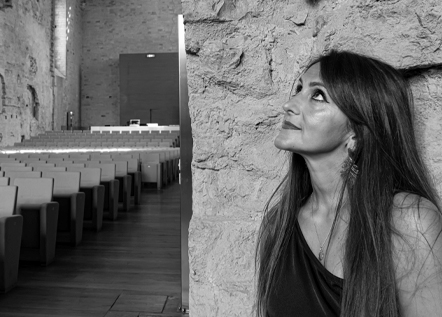
Valentina Borgnini
Art historian
An art historian and teacher of art history, Valentina Borgnini has spent more than twenty years studying and promoting the artistic and monumental heritage of Umbria. She is the author of a detailed study on the history of the San Francesco al Prato complex in Perugia, whose lengthy restoration and reopening as an auditorium she followed closely. She has also curated the narrative of the history of the Cappella degli Oddi, including the virtual repositioning of Raphael’s Coronation of the Virgin, together with various exhibition and educational projects in collaboration with museums and schools across Umbria. She is currently working on a digital twin of the monumental complex and its historical and artistic heritage.
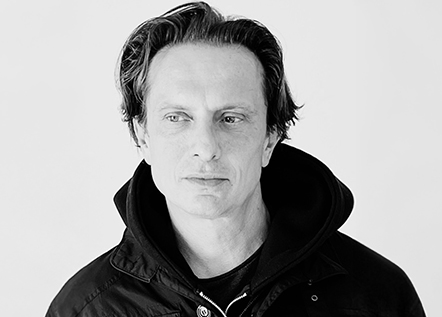
Giovanni Di Leo
Architect
Giovanni Di Leo is an architect who graduated with honours from the University of Naples Federico II, where he went on to pursue further studies through Master’s programmes in Urban Management (Domus Academy) and in Technical Management of Public Works (Oikos), together with research in Sustainable Urban Design (Roma Tre University) and Environmental Reconversion Techniques (University of Campania). After working as a partner at Pica Ciamarra Associati, where he was responsible for environmental quality, he founded GDLA Studio di Architettura in 2005. His work focuses on urban regeneration, sustainability and the quality of living environments, through projects in architecture, urban planning and interior design. Alongside his professional practice, he maintains an intense activity in research, scientific coordination and dissemination on urban policy and design culture. He served as IN/Arch scientific coordinator for the European Windat network (European Commission – DG Energy and Transport), coordinated working groups for the National Centre for Bioclimatic Architecture (ENEA), and acted as a Federcasa consultant on the ecosystemic quality of Neighbourhood Contracts. He has contributed to defining codes for the environmental quality of buildings and living environments, including the code developed for the SEED Festival. He currently coordinates the “Architecture, Europe, Living Environments” programme and is a member of the Scientific Committee and Legislative Commission of the National Institute of Architecture. He also carries out editorial work for the international journal Le Carré Bleu and for L’Industria delle Costruzioni, and has given evidence to the Chamber of Deputies and the Senate on architectural quality, urban regeneration and demographic transition.
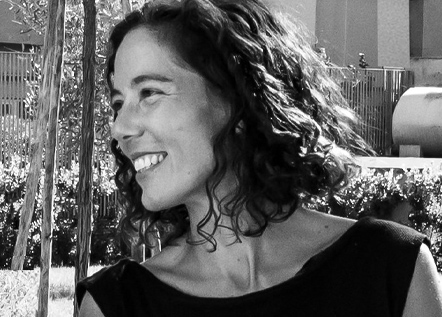
Barbara Cadeddu
Engineer, PhD, curator and strategic consultant
An engineer with a PhD in Architectural and Urban Composition, Barbara Cadeddu works in the fields of strategic planning, local development, and the design, programming and management of complex interventions funded by European, national and regional funds. Her work integrates urban design, social innovation and public policy, with particular attention to territorial regeneration processes, place-based strategies and participatory methodologies. She has held institutional and strategic consultancy positions, including Councillor for Strategic Planning and Community Programming of the Municipality of Cagliari (2013–2016), consultant to the Tourism Councillor of the Autonomous Region of Sardinia (2019–2020), and consultant to KPMG Advisory S.p.A. for technical assistance to the Autonomous Region of Sardinia in implementing the Regional ESF+ Programme 2021–2027 (2023–2024). She currently coordinates the drafting of the Strategic Plan for the Province of Sulcis Iglesiente, is a consultant to the Fondazione Cammino Minerario di Santa Barbara for the development and implementation of the Integrated Territorial Investment under the ERDF Regional Programme Sardinia 2021–2027, and to the Union of Municipalities of Barbagia, Fonni and Orani for the development of project sheets relating to the National Strategy for Inner Areas 2021–2027. Alongside her professional activity, she has held an academic post as a contract professor of Architectural and Urban Design at the University of Cagliari, where she taught and conducted research from 2007 to 2019. In the cultural sphere, she curates and coordinates international programmes dedicated to architecture, design and innovation. Since 2021 she has curated SEED. Design Actions for the Future; since 2020 she has coordinated AJU/AJA, a project dedicated to design and craft culture with scientific responsibility held by Triennale Milano; and she was scientific coordinator of FESTARCH – International Architecture Festival, conceived by Stefano Boeri and promoted by RCS MediaGroup. Since 2023 she has been a member of the Steering Committee of the National Institute of Architecture and an associate member of the Italian Institute of Project Management (ISIPM). Since 2026 she has been President of the Sardinia Section of IN/Arch. She is the author of numerous publications.
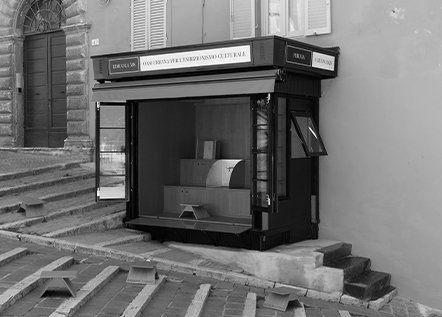
Edicola 518
The "rebel newsstand"
Edicola 518 is the rebel newsstand for lovers of fine paper. We, the artists of Emergenze, founded it on 1 June 2016 on the site of a historic newsagent’s in Perugia, and have made it a bookshop without equal anywhere in the world. Its selection offers a range unique in Italy of independent magazines, artists’ books, anarchist ephemera, fanzines and self-produced works under our own publishing imprint, Emergenze Publishing. We have defined the space of Edicola 518 as four square metres of infinite space.
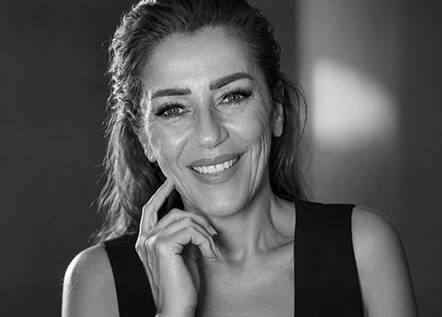
Gabriella Greison
Physicist, writer, actress and science communicator
Gabriella Greison is a physicist, writer, actress and narrator of quantum mechanics. For many years she has brought physics out of the laboratory and onto the stage, turning formulae and equations into stories capable of speaking to everyone. She has written fourteen books and created fourteen theatrical productions dedicated to the leading figures of twentieth-century physics, from Einstein to Dirac, from de Broglie to Leona Woods. Her shows have been staged throughout Italy and abroad, including in Cambridge, Washington and at CERN. She contributes to Radio 24 and Corriere della Sera, where she develops science communication projects with an innovative approach. At the heart of her work lies a single idea: physics is not something remote, but a key to understanding human relationships, emotions and the world around us every day. On the Corriere website she has created the successful series “Scintille”, in which everyday problems, from traffic to unliveable cities, are examined through the physics of complex systems.
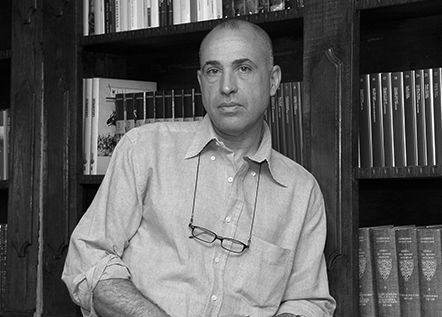
Roberto Marchesini
Ethologist, zooanthropologist and essayist
Philosopher, ethologist and zooanthropologist. Founder and director of the School of Human-Animal Interaction (SIUA) and of the Centre for Post-Humanist Philosophy Studies, based in Bologna, Roberto Marchesini is regarded as one of the world’s leading exponents of zooanthropology, a discipline he helped to found and develop as an autonomous field of research from the 1990s onward. A graduate in Veterinary Medicine in 1985, he has conducted more than thirty years of interdisciplinary research aimed at redefining the role of animals in society, developing a post-humanist philosophy directed at overcoming anthropocentrism. He is the author of more than one hundred publications in philosophy, ethology and animal bioethics, including Post-human. Verso nuovi modelli di esistenza, Fondamenti di zooantropologia and Etologia filosofica. He directs the journal Animal Studies and is among the promoters of the International Society of Zooanthropology. In 2016 a group of international scholars dedicated to him the monograph The Philosophical Ethology of Roberto Marchesini (Routledge).
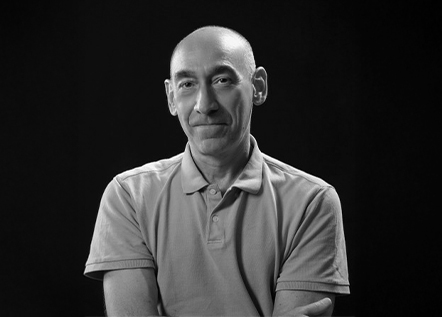
Lucio Nardi
Architect and lecturer
Lucio Nardi studied architecture in Venice (IUAV) and Berlin (UdK – Berlin University of the Arts). In 2005 he obtained a PhD in Architectural Design from IUAV. During the 1990s he worked in Berlin at the practices of Professor Giorgio Grassi (Milan) and Diener & Diener Architekten (Basel). Since 2001 he has practised independently in Berlin, where he has realised projects in industrial and residential architecture and restoration. Since 2010 he has promoted and organised participatory cultural projects in collaboration with residents’ associations, cultural bodies, theatre groups and schools. In particular, projects developed in the mining and industrial areas of former East Germany have been presented at numerous exhibitions and received several awards. He began his academic career in 2001 at the Bauhaus-Universität Weimar. Since then, he has taught in Italy (IUAV Venice, SUN Naples, University of Cagliari) and Germany (Bauhaus-Universität Weimar, UdK Berlin, MSA Münster). He currently teaches architectural and urban design at the Münster School of Architecture and collaborates with the Vietnamese German University in Ho Chi Minh City, Vietnam.
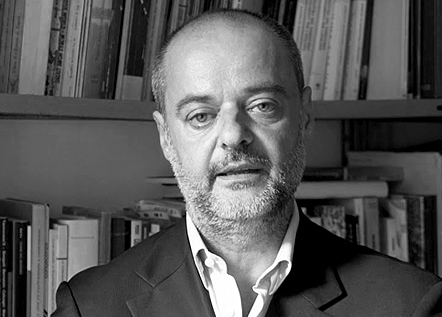
Raffaele Salvoldi
Artist, performer
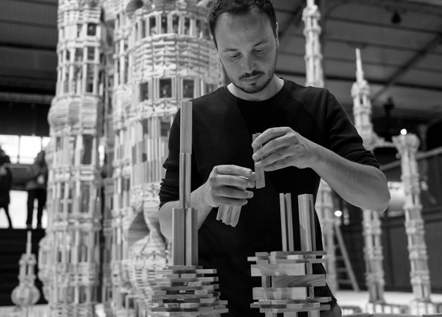
Director of photography for more than ten years in film, advertising and documentary production, collaborating with brands such as Giorgio Armani, Lavazza and Universal Music Italia. In 2021, during lockdown, he began a path of artistic experimentation, creating architectural installations built with Kapla wooden building blocks, combining two long-standing passions: wood and architecture. His works, built live in front of audiences as genuine performances, are eventually dismantled or demolished in a collective event, forming a cycle of construction and deconstruction that reflects on the transience of beauty. In 2019 he created his first permanent installation, La Stanza Magica, at Casa Bossi (Novara), and in 2022 he launched the Wood Arc project. Since 2023 he has collaborated with the Salvatori brand, experimenting for the first time with natural stone — Carrara marble, Pietra d’Avola, Grigio Versilia — to create permanent installation works.
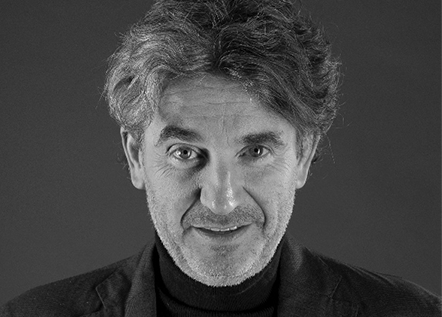
Walter Mariotti
Philosopher and Editorial Director of Domus
Walter Mariotti has been Editorial Director of Domus since 2017, with responsibility for the entire system. A graduate in Theoretical Philosophy from the University of Siena, with periods of research at Leuven and Harvard, following an Executive Programme at SDA Bocconi he obtained a PhD from the University of Bergamo, dedicating his research to the transformation of society and culture in contemporary life. Over the years he has devised and directed innovation projects for Italian and foreign publishers, including ClassEditori, RCS MediaGroup, Mondadori and Gruppo Media TI, participated in the founding of Renzo Piano’s G124 initiative, and provided cultural and strategic consultancy to public and private institutions. He currently teaches at IULM University in Milan and at the University of San Marino. His books include Alfabeto del postcapitalismo, Bellezza and Il tempo della complessità – Dialogo con Mauro Ceruti.
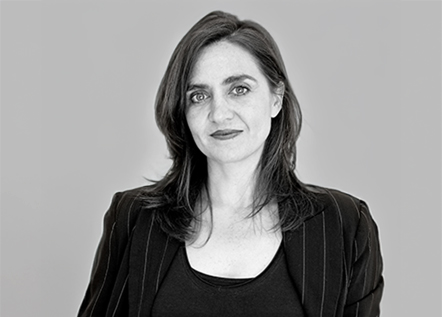
Belinda Tato
Associate Professor of Landscape Architecture, Harvard University
Belinda Tato is Associate Professor in Practice of Landscape Architecture at the Harvard University Graduate School of Design and co-founder, together with José Luis Vallejo, of Ecosistema Urbano, a Madrid-based practice specialising in urban social design that integrates landscape architecture, urban planning and social innovation through the design of spaces and processes intended to strengthen citizen self-organisation and community life, with particular attention to the relationship between the built environment, climate change and contemporary forms of dwelling. Among her best-known projects and urban plans, developed across Europe, Latin America, Asia and the United States, is the Eco-boulevard of Ensanche de Vallecas in Madrid — realised with support from the European Union’s LIFE programme and the Madrid Municipal Housing and Land Company — a pioneering urban regeneration project based on creating microclimates through green systems and bioclimatic strategies. Other notable projects include the regeneration of the West Palm Beach waterfront with the Banyan Hub (Florida, USA), the CUENCA RED Public Space Reactivation Plan (Ecuador), urban and territorial planning for Encarnación (Paraguay), and urban regeneration interventions in Bangladesh, Kyrgyzstan and Mexico. She has taught at international institutions including Yale University, UCLA and the Royal Institute of British Architects (RIBA). Her work has received more than 30 international awards, including a nomination for the Mies van der Rohe Award (2007) and the Silver Award of the Holcim Award for Sustainable Construction (2009).
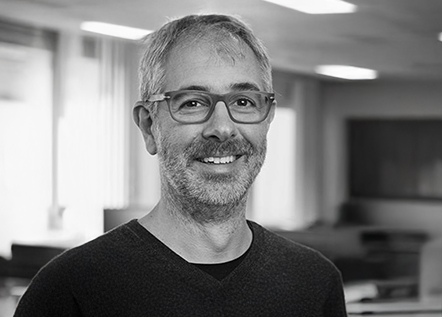
Maurizio Teora
Managing Director of Arup Italia and lecturer, IUAV Master's programme
Managing Director of Arup Italia, based in Milan, where he graduated in Structural Engineering from the Politecnico. From the outset of his career he has been a leading figure in Arup’s quality of practice. He has served as Director in Amsterdam and in Istanbul. Known for his expertise in integrated design and sustainable urban regeneration, Teora is actively involved in academic training and innovation, serving as a lecturer and member of scientific committees at several Italian universities and master’s programmes, including the Politecnico di Milano. As lecturer and as the party responsible for relations between the IUAV master’s programme and Arup, he has established an internship relationship for the “Architecture CO2=0” Master’s programme.