

Program
Filter events by:
Calendar
Seed Perugia | SAN FRANCESCO AL PRATO | AUDITORIUM
MORNING
Hosted by:
Chiara Buratti
RAI Scuola
Seed Perugia
San Francesco al Prato – Digital Twin
Valentina Borgnini
Art historian
Gianluca Falcinelli
Architect
_
Introduction by:
Andrea Margaritelli
Engineer, President of the Guglielmo Giordano Foundation
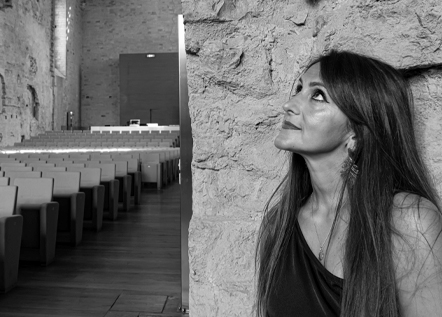 Valentina Borgnini
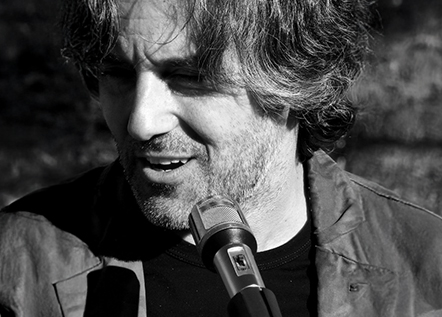 Gianluca Falcinelli
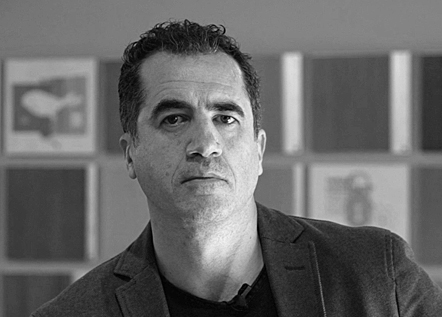 Andrea Margaritelli
Live
Seed Perugia
Seed Scuola
Musical performance by the pupils of the “Annibale Mariotti” Classical and Music High School
Live
Seed Perugia
Being human in the technological age.
The self, learning and relationships
Vittorio Gallese
Neuroscientist and professor
Ugo Morelli
Cognitive scientist and essayist, lecturer in Cognitive Sciences at the University of Naples Federico II
The talk by Vittorio Gallese – a neuroscientist who, in 1992, was part of the team that identified mirror neurons – draws on the book he co-authored with Ugo Morelli, *What Does It Mean to Be Human? Body, Brain and Relationships for Living in the Present*, to bring to Seed a reflection on what distinguishes our species from others and from machines: our interdependence with our fellow human beings and with the environment. From this premise emerges an interpretation of the present, in which our relationship with others and with the world is increasingly mediated by screens and algorithms; an era – our own – in which the plausibility of a response is mistaken for its reliability, and the user becomes accustomed to an interlocutor devoid of subjectivity, designed to agree with us. This is a transformation that directly challenges the culture of design: space, in fact, can either facilitate or hinder relationships, defining possible distances, moments of pause and the likelihood of encounters.
_
Introduction and moderation:
Barbara Binelli
Gestalt counsellor
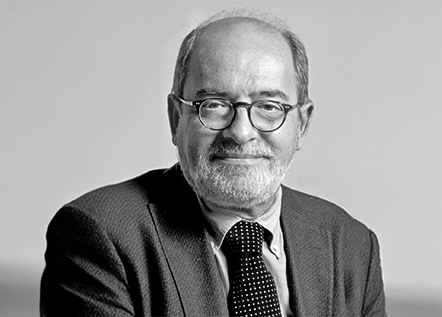 Vittorio Gallese
 Ugo Morelli
 Barbara Binelli
Live
Seed Perugia | SAN FRANCESCO AL PRATO | AUDITORIUM
AFTERNOON
Seed Perugia
Soft Robotic. Human-robot interaction
Matteo Cianchetti
Associate Professor at the BioRobotics Institute
The talk by Matteo Cianchetti, lecturer and director of the Soft Mechatronics for Biorobotics Laboratory at the Sant’Anna School of Advanced Studies in Pisa, will take the audience on a journey of discovery into robotic agents that learn from nature and adopt its strategies: they grow like plants, stretch out and change shape. These robots are constructed from soft components and deformable structures, capable of moving with precision even in the most fragile or critical environments, without causing damage to them or to themselves. From arms inspired by octopus tentacles, which stiffen on command for minimally invasive surgical procedures, to implantable artificial organs such as the hybrid heart, right through to sensitive grippers capable of handling delicate foods, soft robotics is redefining the boundary between the artificial and the biological. A journey of discovery into machines whose intelligence lies not in software, but in the materials, form and arrangement of their parts. An event to reflect on how non-human entities can inhabit the world by adapting symbiotically to their surroundings.
 Matteo Cianchetti
Live
Seed Perugia
“Are you a human architect?” – Master IUAV Architecture CO2=0
Raffaella Laezza
Architect, PhD, Head of Research and Scientific Director at IUAV
Michele Brunello
Founder of Dont’stop Architettura and lecturer at IUAV
Maurizio Teora
Managing Director of Arup Italia and lecturer on the IUAV Master’s programme
 Raffaella Laezza
 Michele Brunello
 Maurizio Teora
Live
Seed Perugia
Living with our differences. Designing sustainable human-robot ecosystems
Luisa Damiano
Philosopher of science and expert in social robotics
Luisa Damiano, a philosopher of science at IULM University, where she heads the PhD School for Communication Studies and co-directs CRiSiCo, the Centre for Research on Complex Systems, takes this idea as her starting point and explores it in new territory. The focus is no longer on disembodied artificial intelligence, but on social robots: technological entities endowed with a body, a voice and a gaze, designed to be recognised as partners to human beings. What happens when these artificial bodies enter our homes, schools and public spaces, learn from us and we learn from them? Damiano explores the philosophical and ethical implications of this and challenges the principle that currently guides social robotics, namely the imitation of humans. An increasingly sophisticated resemblance risks blurring identities and giving rise to delegations of responsibility, substitutions and misplaced expectations, particularly amongst the generations who will grow up alongside these machines. Hence the idea of relationships in which the difference between human and artificial remains recognisable, as a prerequisite for socially and ecologically sustainable coexistence. In the near future, spaces designed on a human scale will have to learn to accommodate these differences, and for designers, a yet unexplored field is opening up, comprising infrastructure and new forms of living.
_
Introduction and moderation:
Barbara Cadeddu
Engineer, PhD, curator and strategic consultant
 Luisa Damiano
 Barbara Cadeddu
Live
Seed Perugia
Extreme Living. Architecture of Words and Music
Raul Pantaleo
Architect, Founder of TAMassociati, lecturer
Nicola Campogrande
Composer, artistic director, music critic
and radio and television presenter
Performance of the quartet piece “Urban Gardens” by Nicola Campogrande
Trio David: Gloria Santarelli – violin, Chiara Mazzocchi – viola, Tommaso Castellano – cello and Claudio Bonfiglio – piano
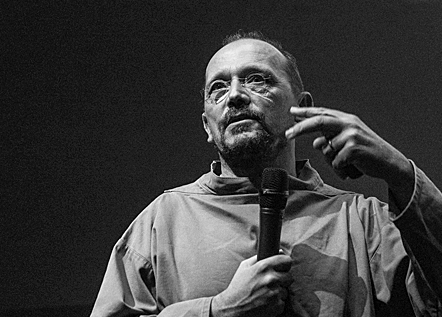 Raul Pantaleo
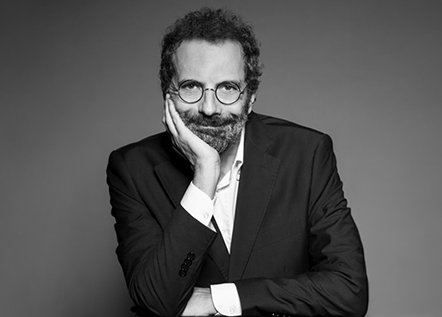 Nicola Campogrande
Live
Seed Perugia
Rethinking Materiality.
Natural resources and Human Resourcefulness
Anupama Kundoo
Founder of Anupama Kundoo Architects
Anupama Kundoo is convinced that architectural imagination, through in-depth research and experimentation with materials, can provide concrete answers to a universal human aspiration: to have shelter, a purpose and a role within the community. In her lecture, she will address the theme of human time as a resource in the search for a new materiality. She will reflect critically on how the logic of ‘time is money’ has driven us towards design dictated by regulations and towards excessive standardisation in industrial production. He will also discuss materials and the consumption of limited natural resources, and their impact on people’s well-being and their capacity for ingenuity. His practice stems from a constant quest for knowledge that enables appropriate building, and he sees every project as an opportunity to generate new knowledge. For architecture is the result of a constructive process, and time must be devoted to that process, even when rapid urbanisation seems to demand haste.
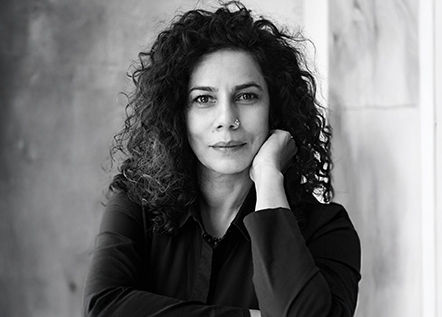 Anupama Kundoo
Live